
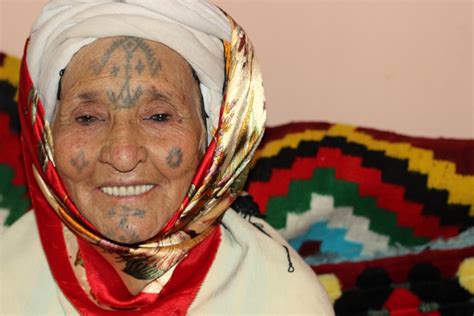
If you travel through the Atlas mountains or the southeast of Morocco, you may meet older Amazigh (Berber) women with blue-green tattoos on their chin, forehead or hands. These marks are one of the oldest art forms in North Africa, and one of the fastest disappearing. Here is what we know about them, and how to approach the subject respectfully on your trip.
A tradition older than Islam in Morocco
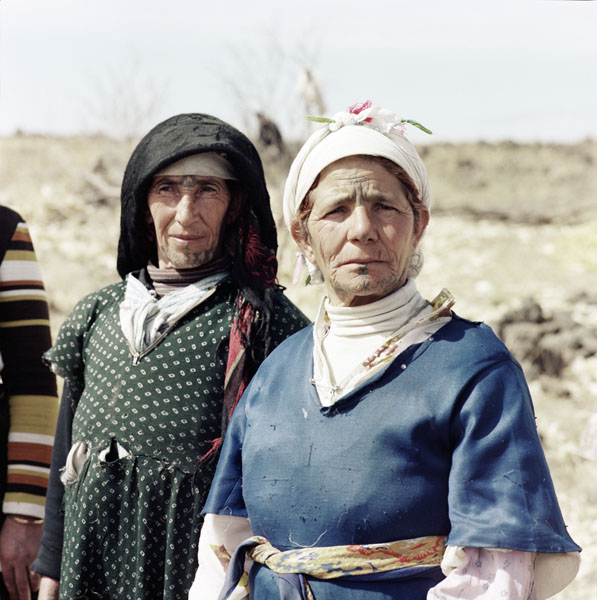
Tattooing among the Amazigh goes back to long before the arrival of Islam in North Africa. Until the middle of the 20th century, many Amazigh women in rural Morocco had facial tattoos, usually done in their teenage years or around the time of marriage. Men were rarely tattooed, and when they were, it was usually a small mark on the hand or wrist.
The tattoos are often called ticherad in Tamazight, though the word changes from region to region, as do the designs themselves. In the past, someone who knew the region could often tell which tribe or valley a woman came from just by looking at her tattoos.
How the tattoos were made
There were no machines. A woman of the village who knew the craft drew the design on the skin, often with charcoal, then pricked along the lines with a needle. A dark mixture, often based on soot or charcoal, was rubbed into the small wounds, sometimes with the juice of plants to deepen the colour. As it healed, the black turned into the blue-green shade you see today. It was painful, and it was done by women, for women.
Where they were placed
- The chin: the most common place, often a vertical line or a branching motif running down from the lower lip.
- The forehead: a small motif between the eyebrows.
- The cheeks and nose: dots and small crosses.
- Hands, wrists and ankles: lines, chevrons and diamonds.
What do the symbols mean?
There is no single dictionary of Amazigh tattoos, and you should be careful with websites that give one exact meaning for every sign. Meanings were passed on orally, they changed between tribes, and many women today simply say the tattoos were “for beauty”. With that in mind, these are the ideas most often connected with them:
- Beauty and identity: a tattoo made a woman more beautiful in the eyes of her community and showed where she belonged.
- Coming of age and marriage: many tattoos marked the passage from girl to woman, or a wedding.
- Protection: diamonds, eyes, triangles and crosses were believed to protect against the evil eye and bad luck, and a tattoo was sometimes used as a remedy.
- Fertility and life: palm and branch shapes, often on the chin, are linked to growth and fertility.
- The natural world: dots, circles and lines can represent the sun, the moon, water, seeds and animals.
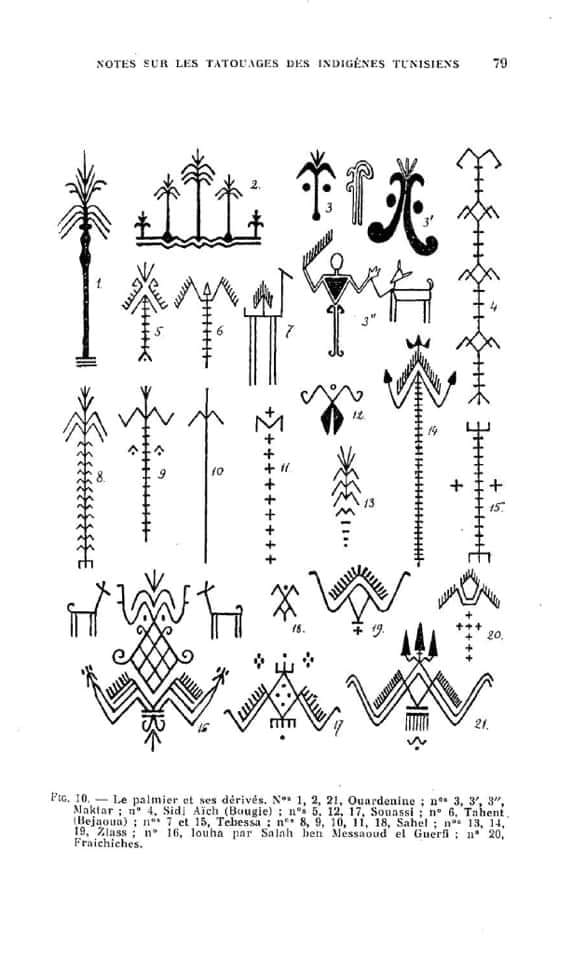
The same geometric language appears everywhere in Amazigh art: in the patterns of the carpets woven by the women of the Atlas, in silver jewelry and fibulas, in painted wooden doors and on pottery. Once you know to look for them, you will see the same diamonds and zigzags in a carpet shop in Marrakech and on the walls of a kasbah in the Dades Valley.
Why the tradition faded
Few women under 60 have traditional tattoos today. Several things changed. Most interpretations of Islam discourage permanent tattoos, and as religious education spread through the countryside, families stopped tattooing their daughters; some older women even tried to have their tattoos removed. Schooling, life in the cities and new ideas of beauty did the rest. Today the women who wear these marks are mostly grandmothers in mountain and desert villages.
Henna and a modern revival
Henna took the place of tattoos for many women. The temporary orange-brown designs on the hands and feet for weddings, Eid and other celebrations often use the same geometric patterns.
At the same time, a new generation of Amazigh artists, designers and tattoo artists is bringing the old symbols back as a sign of pride in Amazigh identity. You will see them on clothing, in jewelry, in graphic design and, more and more, as modern tattoos.
Seeing the tattoos on your trip: please be respectful
Women with traditional tattoos are real people, not an attraction. A few simple rules:
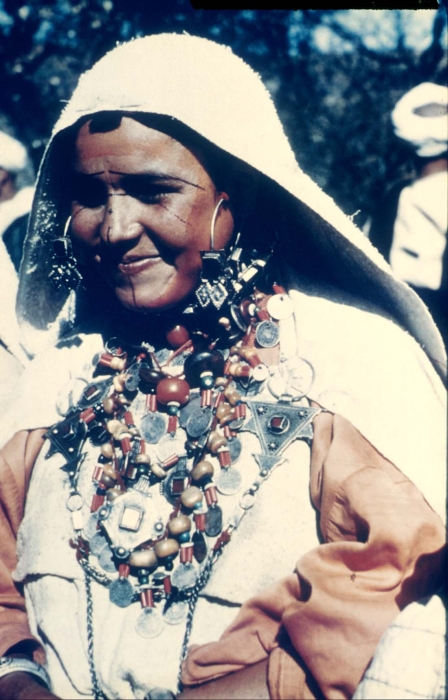
- Never photograph a woman’s face without asking first, and accept a no with a smile. Many older women do not want to be photographed at all.
- Let the conversation come naturally. If you are invited for tea in a village home, your guide can translate, and some women are happy to talk about their tattoos and their youth. Others are not, and that is their choice.
- Look at the art around you: carpets, jewelry and pottery from women’s cooperatives carry the same symbols, and buying from them supports the women who keep the patterns alive.
Our tours through the High Atlas and the southeast pass through Amazigh villages every day. If Amazigh culture is what interests you most, tell us and we can plan more time in villages, a visit to a women’s carpet cooperative and a night with a local family.
Read more: the Amazigh (Berber) people of southeast Morocco.
